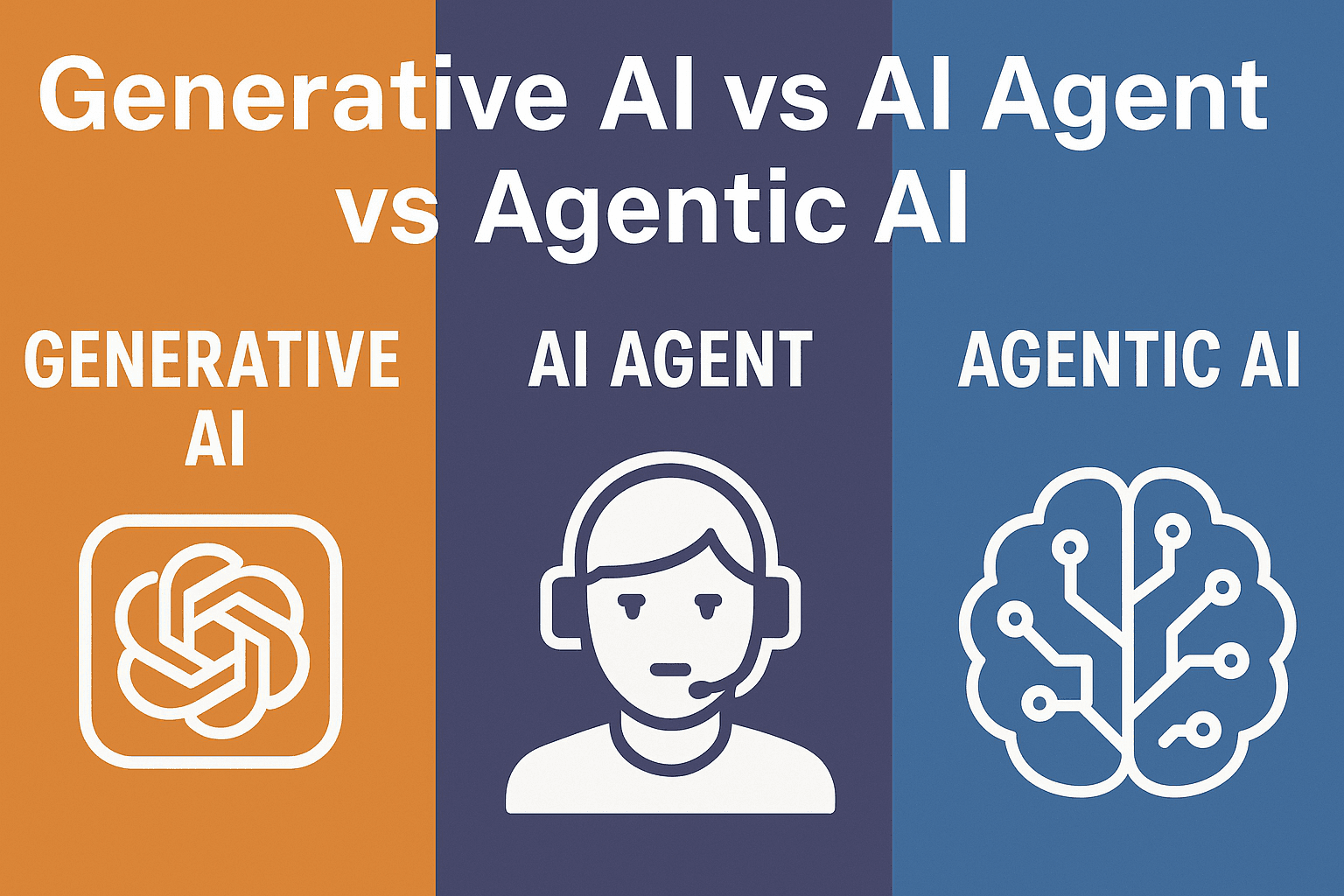
The AI landscape of 2025 is no longer just about chatbots that write poems or generate images. We have entered an era where intelligence is measured by its ability to act, reason, and strategize. To navigate this space, it is essential to distinguish between three core concepts: Generative AI, AI Agents, and Agentic AI.
Generative AI: The Engine of Creation
Generative AI refers to models designed to create new content based on patterns learned from existing data. Whether it is text, code, or high-fidelity imagery, the primary focus is on output generation.
Key Characteristics:
- Probabilistic Logic: Predicting the next token or pixel based on statistical likelihood.
- Human-in-the-Loop: Requires precise prompting and iterative feedback to produce high-quality results.
- Pattern Recognition: Exceptional at synthesizing vast amounts of information into coherent summaries or creative works.
Generative AI is the modern digital easel—a tool that amplifies human creativity but remains stationary without a hand to guide it.
AI Agents: Proactive Task Execution
AI Agents represent the first step toward autonomy. Unlike basic Generative AI, an agent is designed to execute specific tasks by interacting with external tools and APIs.
Operational Architecture:
- Tool Use: The ability to browse the web, execute code, or update a database through function calling.
- Observation-Action Loops: Agents observe the environment, decide on an action, and process the result to refine their next move.
- Specialization: Typically optimized for narrow domains like customer support, scheduling, or data retrieval.
If Generative AI is the engine, AI Agents are the vehicle. They don't just process information; they move it through a workflow.
Agentic AI: Strategic Autonomy
Agentic AI sits at the top of the spectrum. It is defined by its ability to handle high-level goals through self-directed reasoning, complex multi-step planning, and dynamic adaptation.
Core Differentiators:
- Goal-Oriented Planning: Instead of following a rigid script, it breaks down a complex mission (e.g., "Conduct market research on renewable energy") into smaller, self-managed sub-tasks.
- Self-Correction: Recognizes when a path is failing and pivots its strategy without human intervention.
- Memory and Context: Maintains a deep "long-term memory" of project goals, previous mistakes, and evolving constraints.
Comparative Analysis: The Intelligence Hierarchy
| Dimension | AI Agent | Agentic AI |
|---|---|---|
| Autonomy | Rule-based execution within boundaries | Self-directed goal discovery |
| Reasoning | Reactive to immediate inputs | Strategic, long-term planning |
| Complexity | Linear, single-step tasks | Non-linear, evolving workflows |
| Example | An auto-responder for email | A virtual project manager |
The Path Forward
In this evolving ecosystem, the most successful implementations will leverage all three layers. Generative AI provides the creative spark, AI Agents handle the heavy lifting of execution, and Agentic AI provides the strategic oversight required for truly autonomous innovation.
We are moving from an era of tools that respond to an era of systems that think ahead.